
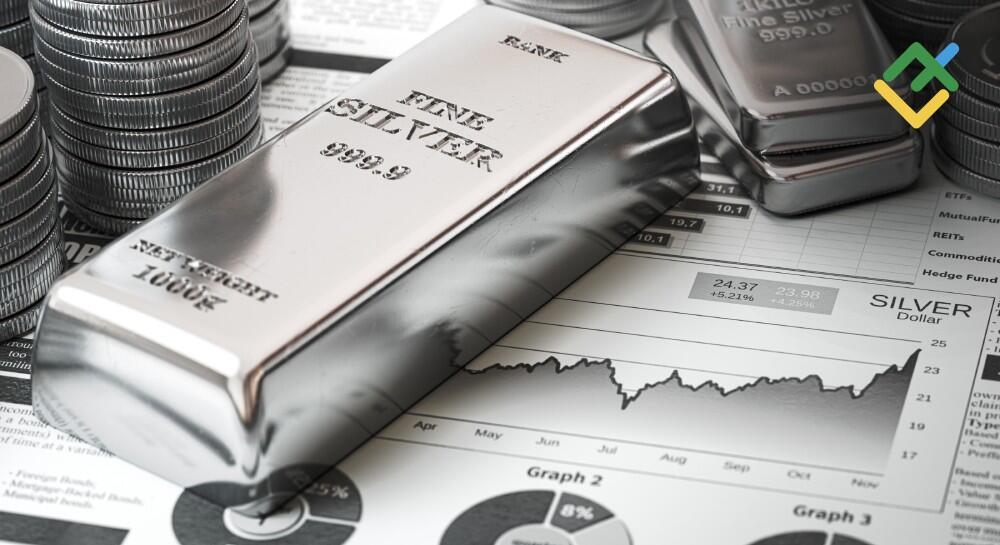

Silver is one of the most sought-after precious metals worldwide. It attracts investors seeking protection against economic uncertainty while remaining in high demand across numerous industries.
Silver price forecasts take into account a wide range of factors, including global economic conditions, the monetary policies of major central banks, industrial demand, geopolitical developments, and market sentiment.
This article explores the historical performance of the XAGUSD pair and reviews forecasts from leading market analysts to assess silver’s price prospects for 2026, 2027, 2028, and the years ahead.
The article covers the following subjects:
Major Takeaways
-
Silver is trading at $65.415 as of 17.09.2026. Over the past 24 hours, the price has changed by +1.50%.
-
Silver reached its all-time high of $121.636 on 29.01.2026, which is 46.22% away from the current price.
-
Silver hit an all-time low of $3.530 on 22.02.1991, a level that differs from today’s price by 1,753.10%.
-
The difference between the all-time high and all-time low is 3,345.78%.
-
Current market sentiment for silver shows that 50.80% of traders favor the following position: balanced.
-
Silver price analysis and forecasts indicate that XAGUSD will trade between $47.016 and $87.149 by the end of 2026.
-
According to long-term forecasts, the silver price may reach $72.587 over the next 5 years and $76.648 over the next 10 years. By 2050, the metal is expected to hit $88.750.
Silver Real-Time Market Overview
|
Metric |
Value |
|
Current spread |
27.0 |
|
Price change over 24 hours |
+1.50% |
|
Price change over 30 days |
+2.30% |
|
52-week range |
$41.495 – $121.300 |
|
Price change over 1 year |
+56.79% |
|
Volatility (30 days) |
+80.00% |
|
Trading volume over 24 hours |
$29,614 |
|
All-time high |
$121.636 on 29.01.2026 |
|
All-time low |
$3.530 on 22.02.1991 |
|
US inflation, y/y |
+3.35% |
|
US Fed interest rate |
+3.63% |
Metrics Definitions:
-
The spread reflects the current cost of trading and represents the difference between the bid and ask prices.
-
The price change over 24 hours and 30 days provide insight into short-term and medium-term market trends.
-
The 52-week range shows the highest and lowest price levels recorded over the past year. The lower boundary may serve as a potential support level and buying zone, while the upper boundary can act as a resistance level and a possible profit-taking area.
-
The price change over 1 year helps assess the long-term direction and strength of the market trend.
-
Volatility measures the degree of price fluctuations. For silver, this metric is particularly important, as the metal tends to experience larger price swings than gold.
-
Trading volume over 24 hours indicates the level of market activity and the liquidity of the instrument.
-
ATH (All-Time High) and ATL (All-Time Low) represent the highest and lowest prices recorded over the entire observation period.
-
US inflation influences silver’s investment appeal. Rising inflation often boosts demand for the metal as a safe-haven asset, supporting its price.
-
The US Fed interest rate has a significant impact on silver prices. Higher rates generally reduce demand for precious metals by increasing the attractiveness of yield-bearing assets and strengthening the US dollar.
Silver Price Forecast and Analysis for Today 17.09.2026
Technical analysis helps evaluate silver’s price outlook using historical market data, chart patterns, and technical indicators. This approach can be used to identify the prevailing trend, determine key support and resistance levels, and spot potential entry and exit points.
We perform technical analysis across multiple time frames, from M30 to H4, to capture both short-term price movements and broader market trends. This approach enables traders to apply the resulting signals to intraday, swing, and other trading strategies while managing risk through clearly defined take-profit and stop-loss levels.
The daily XAGUSD chart shows that the price is moving between $63.280 and $66.250.
The ADX indicator suggests the following trend: weak (8), upward. When the ADX value is above 25–30, the trend is considered strong, while lower readings may indicate a sideways market or a potential reversal.
Moving averages, the Bollinger Bands, Ichimoku, Stochastic, MACD, Williams %R, and ZigZag indicators offer the following signals for intraday trading:
-
M30 — buy.
-
H4 — buy.
Signal based on the RSI reading and overbought/oversold conditions: wait.
Signals for short-term trades generated by Bollinger Bands, EMA21, and EMA50:
Weekly Silver Price Forecast and Technical Analysis as of 17.09.2026
For our weekly XAGUSD forecast, we analyze signals from key technical indicators on the daily chart and use the Ichimoku Cloud on the weekly time frame to evaluate the medium-term outlook. This approach helps determine the most likely direction of price movement, identify potential targets, and establish appropriate stop-loss and take-profit levels.
Silver is trading between $54.998 and $72.620 on the weekly chart.
Recommendation based on the MA10, MA20, MA50, and MA100 moving averages and the Bollinger Bands, Ichimoku, Stochastic, MACD, Williams %R, and ZigZag indicators on the D1 time frame: sell.
Signals for medium-term trades:
-
Trend based on Ichimoku Cloud signals on the weekly time frame — downward.
-
Recommended entry point — $76.191.
-
Take-Profit for the coming week — $97.640.
-
Stop-Loss — $52.598.
This approach allows traders to capitalize on medium-term price movements, account for silver’s historically high volatility, and manage trading risks more effectively.
Silver Price Forecast for 2026 Based on Technical Analysis
Our long-term forecasts are based on a comprehensive analysis of historical XAGUSD price trends, precious metals market volatility, industrial demand cycles, macroeconomic conditions, and the results generated by our proprietary forecasting model for 2026.
-
The minimum price of silver is expected to reach $47.016 in 2026. This scenario is possible if the US dollar strengthens, the global economy decelerates, industrial demand declines, and interest rates remain high.
-
The maximum price may reach $87.149 if global economic growth accelerates, demand from the solar energy and electronics industries increases, and major central banks ease monetary policy.
-
According to our calculations, the average annual price will be around $64.112, representing a change of -1.99% from the previous year’s closing price.
The table below presents the silver price forecast for 2026, with rounded estimates of how prices could move throughout the year:
| Date | Minimum, $ | Average Price, $ | Maximum, $ |
|---|---|---|---|
| 15.10.2026 | 47.016 | 64.483 | 87.149 |
| 15.11.2026 | 61.190 | 63.410 | 65.629 |
| 15.12.2026 | 61.884 | 64.295 | 66.706 |
What Other Analysts Predict for Silver in 2026
Expert forecasts generally point to silver maintaining positive momentum throughout the remainder of 2026. Analysts expect prices to strengthen notably in the autumn, although estimates of the potential upside vary. A correction may follow after silver reaches local highs, but most of the scenarios reviewed do not anticipate a significant bearish reversal.
LongForecast
According to LongForecast, silver is expected to maintain its upward momentum in the autumn of 2026. The closing price is projected to rise from $75.18 in September to a peak of $84.79 in November, before edging down to $83.70 in December. Meanwhile, the upper end of the forecast range is expected to climb from $78.94 to $89.03 in November. This suggests a sustained upward trend, followed by a moderate correction toward the end of the year.
WalletInvestor
According to WalletInvestor, silver is forecast to rally sharply in the autumn of 2026, with the price rising from $68.22 in September to $80.25 in October. The trend is then expected to reverse, with prices falling to $75.16 in November and $74.88 in December. This suggests a moderate correction following the October peak, followed by price stabilization.
CoinCodex
Analysts at CoinCodex expect silver to strengthen significantly in the autumn of 2026. According to the forecast, the average price is projected to rise from $72.52 in September to $82.11 in October, reaching a peak of $100.02 in November. A correction is expected in December, with the average price declining to $89.41. At the same time, the projected price range remains wide, indicating that market volatility is likely to stay elevated.
How We Forecast Silver Prices
Our forecasting framework combines a proprietary Bayesian dynamic hierarchical factor model, enhanced with kernel methods and automated hyperparameter optimization, with fundamental analysis and consensus forecasts sourced from leading analytical platforms.
The model ingests and analyzes thousands of historical data points alongside current fundamental drivers of the silver market, including Fed interest rates, inflation dynamics, industrial production trends, geopolitical risks, investment demand, ETF capital flows, real bond yields, and demand from the solar energy sector and other silver-intensive industries.
Using this data, the model identifies complex nonlinear relationships and produces not a single price point, but a probabilistic price range that captures market uncertainty.
The Bayesian framework enables continuous forecast refinement as new information arrives, effectively separating meaningful signals from market noise. The resulting forecast is rigorously grounded and regularly updated, then benchmarked against estimates from major banks, investment firms, and analytical agencies.
Important: Even the most sophisticated model cannot guarantee accurate results. Unforeseen events such as geopolitical crises, sudden shifts in monetary policy, or significant changes in industrial demand can alter silver price trajectories at any moment.
Silver Price Forecast for 2027 Based on Technical Analysis
Based on historical price trends, macroeconomic factors, industrial demand, and our analytical model, the following levels can be projected for 2027:
-
The minimum price will be $60.409 if the US dollar strengthens, global economic growth slows down, and demand from industrial consumers declines.
-
The maximum price will reach $69.158 if global economic growth accelerates, silver consumption in the solar energy and electronics sectors increases, and investment demand for precious metals rises.
-
The average annual price is expected to trade at $64.465, representing a change of +0.55% compared to the closing price in 2026.
The table below presents a month-by-month forecast for 2027. These estimates can be used for medium- and long-term planning, as well as for developing investment and hedging strategies:
| Date | Minimum, $ | Average Price, $ | Maximum, $ |
|---|---|---|---|
| 15.01.2027 | 61.657 | 64.226 | 66.795 |
| 15.02.2027 | 60.972 | 63.679 | 66.385 |
| 15.03.2027 | 61.350 | 64.241 | 67.132 |
| 15.04.2027 | 61.572 | 64.643 | 67.713 |
| 15.05.2027 | 60.884 | 64.089 | 67.293 |
| 15.06.2027 | 61.099 | 64.485 | 67.870 |
| 15.07.2027 | 60.409 | 63.925 | 67.441 |
| 15.08.2027 | 61.066 | 64.791 | 68.517 |
| 15.09.2027 | 60.819 | 64.701 | 68.583 |
| 15.10.2027 | 61.329 | 65.244 | 69.158 |
| 15.11.2027 | 60.492 | 64.353 | 68.214 |
| 15.12.2027 | 61.294 | 65.207 | 69.119 |
Practical recommendations:
-
Consider long trades near strong support levels.
-
Take part of your profits when the price approaches key resistance levels.
-
Review your positions regularly following Fed decisions, the release of inflation data, and the publication of key industrial activity indicators, since these can significantly impact the silver market.
Silver Price Forecast for 2028 Based on Technical Analysis
The analysis of the silver-to-US dollar exchange rate trends over the past few years, key macroeconomic factors, and our forecasting model suggest the following levels for 2028:
-
The minimum price may reach $60.651.
-
The maximum price may hit $69.788.
-
The average annual price may reach $65.166, representing a change of +1.09% compared to the closing price in 2027.
Below is the XAGUSD price forecast for 2028:
| Date | Minimum, $ | Average Price, $ | Maximum, $ |
|---|---|---|---|
| 15.01.2028 | 61.198 | 65.104 | 69.010 |
| 15.02.2028 | 60.651 | 64.522 | 68.394 |
| 15.03.2028 | 61.147 | 65.050 | 68.953 |
| 15.04.2028 | 61.491 | 65.416 | 69.341 |
| 15.05.2028 | 60.938 | 64.827 | 68.717 |
| 15.06.2028 | 61.279 | 65.190 | 69.101 |
| 15.07.2028 | 60.722 | 64.598 | 68.474 |
| 15.08.2028 | 61.509 | 65.435 | 69.362 |
| 15.09.2028 | 61.400 | 65.319 | 69.238 |
| 15.10.2028 | 61.888 | 65.838 | 69.788 |
| 15.11.2028 | 61.032 | 64.928 | 68.824 |
| 15.12.2028 | 61.820 | 65.766 | 69.712 |
Silver Price Forecast for 2029 Based on Technical Analysis
According to long-term macroeconomic trends, industrial consumption outlook, and global economic projections, the following price levels are expected in 2029:
-
The minimum price will reach $61.160.
-
The maximum price may hit $70.472.
-
The average annual price may stand at $65.757, representing a change of +0.91% compared to the closing price in 2028.
Here is the XAGUSD price forecast for 2029:
| Date | Minimum, $ | Average Price, $ | Maximum, $ |
|---|---|---|---|
| 15.01.2029 | 61.713 | 65.652 | 69.591 |
| 15.02.2029 | 61.160 | 65.063 | 68.967 |
| 15.03.2029 | 61.653 | 65.589 | 69.524 |
| 15.04.2029 | 62.000 | 65.957 | 69.915 |
| 15.05.2029 | 61.453 | 65.375 | 69.298 |
| 15.06.2029 | 61.804 | 65.749 | 69.694 |
| 15.07.2029 | 61.263 | 65.173 | 69.084 |
| 15.08.2029 | 62.068 | 66.030 | 69.992 |
| 15.09.2029 | 61.981 | 65.937 | 69.893 |
| 15.10.2029 | 62.494 | 66.483 | 70.472 |
| 15.11.2029 | 61.666 | 65.602 | 69.538 |
| 15.12.2029 | 62.483 | 66.471 | 70.460 |
Silver Price Forecast for 2030 Based on Technical Analysis
Taking into account historical trends in silver prices, cycles in industrial demand, and long-term macroeconomic trends, the following levels are projected for 2030:
-
The minimum price may reach $61.887.
-
The maximum price will stand at $71.581.
-
The average annual price will be $66.673, representing a change of +1.39% compared to the closing price in 2029.
The table below shows the XAGUSD forecast for 2030:
| Date | Minimum, $ | Average Price, $ | Maximum, $ |
|---|---|---|---|
| 15.01.2030 | 62.408 | 66.391 | 70.374 |
| 15.02.2030 | 61.887 | 65.837 | 69.787 |
| 15.03.2030 | 62.413 | 66.397 | 70.381 |
| 15.04.2030 | 62.793 | 66.801 | 70.809 |
| 15.05.2030 | 62.278 | 66.254 | 70.229 |
| 15.06.2030 | 62.662 | 66.661 | 70.661 |
| 15.07.2030 | 62.150 | 66.117 | 70.084 |
| 15.08.2030 | 62.983 | 67.003 | 71.023 |
| 15.09.2030 | 62.920 | 66.936 | 70.952 |
| 15.10.2030 | 63.455 | 67.505 | 71.555 |
| 15.11.2030 | 62.645 | 66.644 | 70.642 |
| 15.12.2030 | 63.477 | 67.529 | 71.581 |
Long-Term Silver Price Forecast Through 2050
Forecasting silver prices through 2050 presents an inherent challenge, given that the global economy, industrial structure, energy sector, and financial markets may shift substantially over such an extended horizon. It is also worth noting silver’s dual nature as it functions as both a precious metal and a critical industrial material.
Nevertheless, such forecasts provide a general overview of possible market scenarios and can be used in developing a long-term investment strategy.
These estimates should be viewed merely as possible scenarios, rather than precise price targets. Therefore, do not rely on them as the sole basis for investment decisions.
Based on our jump-diffusion model, silver is expected to trade within the range of $77.110–$88.750 by 2050.
The long-term low reflects a conservative scenario: persistently low inflation, a strong US dollar, slowing industrial production, and weakening demand from high-tech sectors.
The long-term high reflects an optimistic scenario: accelerated growth in solar energy, electronics, and other silver-intensive industries, rising investment demand for precious metals, and eroding confidence in fiat currencies amid elevated debt levels across major economies.
| Year | Minimum, $ | Average Price, $ | Maximum, $ |
|---|---|---|---|
| 2033 | 64.200 | 68.992 | 73.901 |
| 2034 | 64.928 | 69.909 | 75.011 |
| 2035 | 65.940 | 70.936 | 76.017 |
| 2036 | 66.734 | 71.637 | 76.648 |
| 2037 | 67.243 | 72.229 | 77.332 |
| 2038 | 67.971 | 73.146 | 78.443 |
| 2039 | 68.983 | 74.173 | 79.449 |
| 2040 | 69.777 | 74.876 | 80.081 |
| 2041 | 70.287 | 75.468 | 80.766 |
| 2042 | 71.016 | 76.385 | 81.877 |
| 2043 | 72.028 | 77.413 | 82.884 |
| 2044 | 72.823 | 78.116 | 83.516 |
| 2045 | 73.333 | 78.708 | 84.201 |
| 2046 | 74.062 | 79.626 | 85.312 |
| 2047 | 75.075 | 80.655 | 86.320 |
| 2048 | 75.870 | 81.358 | 86.952 |
| 2049 | 76.381 | 81.951 | 87.638 |
| 2050 | 77.110 | 82.869 | 88.750 |
Sentiment in News and Social Media Activity
Social sentiment reflects the collective opinions, expectations, and assessments of traders, investors, and analysts as expressed in news outlets, social media, and specialized financial platforms. Analyzing sentiment helps anticipate potential movements in the XAGUSD pair. Positive news tends to support prices, while negative sentiment often triggers a correction or a broader decline.
Media buzz refers to the total volume of mentions and discussions about silver across news outlets and social media. Sentiment reflects the prevailing tone of this coverage: bullish, bearish, or neutral.
Intense discussions combined with prevailing positive sentiment often indicate growing interest among market participants and may precede price increases. Conversely, a surge in negative sentiment may indicate mounting pressure on the price. At the same time, analysis of the news backdrop and social media activity should be viewed as a supplementary tool that works most effectively in conjunction with technical and fundamental analysis.
Latest News and Sentiment on Social Media
We assess sentiment in real time using FinBERT, a language model fine-tuned for financial sentiment analysis. Our analysis draws on data from more than 50 authoritative sources, including Bloomberg, Reuters, CNBC, MarketWatch, and other leading business publications, as well as major social media platforms and specialized communities (X, Reddit, Telegram, Discord).
Current sentiment for silver, based on news and social media posts: Neutral.
Today’s media buzz level for silver: Medium.
Research consistently shows that a surge in mentions paired with positive sentiment tends to signal growing investor interest and may precede a price rally. Conversely, negative sentiment spikes during high-activity periods often coincide with heightened volatility and can offer profitable entry points.
Silver Market Sentiment
Market sentiment reflects the actual distribution of trader positions in silver, showing what percentage of market participants are long and what percentage are short. This indicator captures the current mood of the market but should not be interpreted as a direct forecast of future price movements.
Silver holds a special place among precious metals, as its price depends on both investment demand and the state of the global economy.
Therefore, market sentiment on XAGUSD is particularly valuable during shifts in Fed monetary policy, key macroeconomic data releases, rising inflation expectations, and changes in manufacturing activity across major economies. When the majority of traders are positioned on one side of the market, the probability of a correction increases.
For this reason, it is advisable to use this indicator in conjunction with technical and fundamental analysis.
Currently, 50.80% of traders are favoring the following position: balanced.
Positions of Major Players on Silver (COT Report)
The COT (Commitments of Traders) report is published weekly by the US Commodity Futures Trading Commission (CFTC) and reflects the distribution of positions across the main categories of market participants: commercial hedgers, large speculators, and retail traders. When analyzing the silver outlook, particular attention is paid to the net positions of large speculators, such as hedge funds and asset managers, as these best reflect institutional investor sentiment.
Data as of 08.09.2026.
Large speculators hold 36,245 long contracts and 10,196 short contracts, with a net position of +26,049 contracts. The net position of commercial hedgers stands at -44,908 contracts.
Current COT signal for silver: Neutral.
A rising net long position among large speculators typically indicates growing bullish sentiment among professional market participants. Conversely, a declining net position may signal deteriorating sentiment and weakening demand. Since silver is more volatile than most precious metals, sharp shifts in COT positioning often precede significant price moves. Thus, COT data is widely used as a leading indicator alongside technical and fundamental analysis.
Silver Price History (XAGUSD)
Silver reached its all-time high of $121.636 on 29.01.2026. The lowest price of silver was recorded on 22.02.1991 when the asset declined to $3.530.
The chart below shows the XAGUSD price movement over the past ten years. Analyzing historical data helps provide a better understanding of silver’s price behavior and improves the accuracy of long-term forecasts.
-
In 2021, the price of silver was influenced by the global economic recovery following the COVID-19 pandemic. Rising industrial activity and strong demand from electronics and solar panel manufacturers buoyed prices, but a stronger US dollar and expectations of tighter monetary policy by the Fed limited the potential for further gains.
-
In 2022, silver faced heightened volatility. Geopolitical tensions, accelerating inflation, and rising demand for safe-haven assets supported the market, but aggressive interest rate hikes by major central banks curbed the upward momentum.
-
In 2023 and 2024, expectations of monetary policy changes, the state of global industry, US dollar movements, and the development of green energy all influenced silver prices. The market remained sensitive to both macroeconomic data and shifts in investment demand.
-
In 2025, silver exhibited elevated volatility amid fluctuating expectations regarding Fed interest rates, changing industrial demand, and geopolitical developments. Increased use of the metal in the solar energy sector and the production of high-tech products bolstered the market.
-
In 2026, investment and industrial demand continued to influence the price of silver. Expectations of monetary policy easing, global economic conditions, and the pace of the energy transition remained key factors determining the direction of XAGUSD prices. Due to its high sensitivity to changes in market sentiment, silver retained its status as one of the most volatile precious metals.
Silver Price Fundamental Analysis (XAGUSD)
For XAGUSD fundamental analysis, key factors include macroeconomic indicators, global industrial conditions, central bank policy, geopolitical developments, and long-term sectoral trends. Moreover, silver’s dual role as both a precious metal and an industrial commodity exposes its price to a wider range of influences than most other safe-haven assets.
What Factors Affect the Silver Price?
The silver price depends on a variety of economic, financial, and industry-specific factors:
-
Interest rate hikes typically put pressure on silver, as investors begin to favor fixed-income instruments and the US dollar gains additional support.
-
Silver is often viewed as a hedge against inflation. As consumer prices accelerate, investor interest in precious metals may increase, driving up prices.
-
During geopolitical instability and economic uncertainty, demand for safe-haven assets rises. Under such conditions, silver often appreciates alongside other precious metals.
-
Silver is traded in US dollars, so fluctuations in the greenback directly affect the price of XAGUSD. A strong dollar typically weighs on silver, while a weaker dollar tends to drive its price higher.
-
The industrial sector accounts for a significant portion of global demand for silver. The state of the electronics, solar energy, automotive, medical, and high-tech sectors can greatly influence long-term price trends.
-
The balance between global supply and demand remains one of the key factors influencing the price of silver. Changes in production, refining, and industrial consumption can cause sharp price swings.
More Facts About Silver
Silver is one of the oldest precious metals, with a history of human use spanning several millennia. Over the centuries, it has served as a medium of exchange, the foundation of monetary systems, and a symbol of wealth. Its limited supply, durability, and unique physical properties have allowed silver to retain its value to this day, keeping it an important component of the global financial system.
Unlike most precious metals, silver has a dual nature. It serves as both an investment asset, used to preserve capital during periods of economic uncertainty, and a key industrial material. With the highest electrical conductivity of any metal, silver is widely used in electronics, solar energy, battery manufacturing, medical equipment, and telecommunications. It also plays a significant role in jewelry and the production of bullion coins and bars.
Silver is popular among traders and investors for its high liquidity and greater volatility relative to gold. This combination makes the XAGUSD pair an attractive instrument for both long-term investing and active trading. With demand from high-tech industries and the energy sector continuing to grow, silver remains one of the most strategically important metals in the global economy.
Advantages and Disadvantages of Investing in Silver
Silver appeals to both traders and investors through its unique combination of investment merit and robust industrial demand. As a portfolio diversifier, it offers distinct advantages. However, it is essential to consider not only the potential benefits but also the associated risks before investing.
Advantages
-
Inflation hedge. Like other precious metals, silver is widely regarded as a store of value during periods of rising prices. When inflation accelerates, investor demand for silver tends to increase, supporting its price.
-
Portfolio diversification. Adding silver to a portfolio helps reduce overall risk through diversification across asset classes. Over the long term, silver prices often move independently of stocks and bonds, though correlations tend to rise during periods of market stress.
-
Strong industrial demand. Unlike most precious metals, silver is extensively used in electronics, solar energy, healthcare, and high-tech manufacturing, creating a durable source of long-term demand.
-
Liquidity. Silver trades actively on global financial markets and offers high liquidity, allowing investors to enter and exit positions relatively quickly through exchange-traded instruments, ETFs, and CFDs.
Disadvantages
-
No passive income. Silver generates neither dividends nor interest payments. An investor’s return depends solely on changes in the asset’s market price.
-
Higher volatility. Silver typically exhibits more dramatic price swings than gold, which amplifies potential gains but equally increases the risk of losses, particularly in short-term trading.
-
Storage and insurance costs. When holding physical silver, investors must account for storage, transportation, and insurance costs. For this reason, many market participants prefer silver CFDs, which allow them to profit from price movements without taking ownership of the physical metal.
-
Sensitivity to the global economy. Since a significant share of silver demand comes from industry, any slowdown in economic growth or decline in manufacturing activity can weigh on its price. This makes silver more responsive to economic cycles than gold.
Conclusion: Is Silver a Good Investment?
Silver sits at the intersection of precious metals and industrial materials, making it sought after by both investors and manufacturers alike. During periods of inflation, economic uncertainty, and rising demand from high-tech industries, silver demonstrates significant growth potential. Its widespread use in electronics, solar energy, and other high-growth sectors adds further long-term appeal to the XAGUSD pair.
However, silver generates no passive income in the form of dividends or interest. Moreover, its price is generally more volatile than gold, with significant swings driven by shifts in industrial demand, monetary policy, and market sentiment. Thus, those holding physical silver should also factor in storage and insurance costs.
Although silver is not a universal investment solution, it can play a meaningful role in a well-diversified portfolio. The XAGUSD pair offers a degree of inflation protection and helps broaden exposure beyond traditional asset classes. Nevertheless, before opening positions, it is crucial to conduct both technical and fundamental analysis and take professional analysts’ views into account.
XAGUSD Price Prediction FAQs
Price chart of XAGUSD in real time mode
The content of this article reflects the author’s opinion and does not necessarily reflect the official position of LiteFinance broker. The material published on this page is provided for informational purposes only and should not be considered as the provision of investment advice for the purposes of Directive 2014/65/EU.
According to copyright law, this article is considered intellectual property, which includes a prohibition on copying and distributing it without consent.
Feed from Litefinance.com